
For many travelers, the biggest mystery surrounding flying by private jet is not the plane itself, but the airport experience. Commercial air travel has led many to expect long lines, crowded airports, security delays, and strict flight schedules. However, flying by private jet is an entirely different world, where efficiency, discretion, and flexibility are the guiding principles.
For many, learning how private airport terminals operate, what to expect when arriving, and how logistics are handled can help alleviate concerns and make an informed decision. In fact, the airport experience is where the time-saving benefits of flying by private jet are most apparent.
How Private Terminals (FBOs) Work
Private jet flights operate out of private terminals named Fixed Base Operators (FBOs). These are special terminals within an airport, designed exclusively for private flights, crews, and passengers.
Essentially, an FBO is the departure lounge, arrival lounge, security checkpoint, and, in some cases, the customs facility when traveling internationally, all rolled into one. It is also where the behind-the-scenes logistics of flying a plane are coordinated, including fuel, catering, and cleaning services.
Inside, the atmosphere is peaceful and comfortable. Instead of airline ticket counters, you will find reception areas, which are more like exclusive lounges. In fact, some FBOs offer meeting rooms, work areas, refreshments, and comfortable seating, while some even feature shower suites, meeting rooms, and play areas for kids.
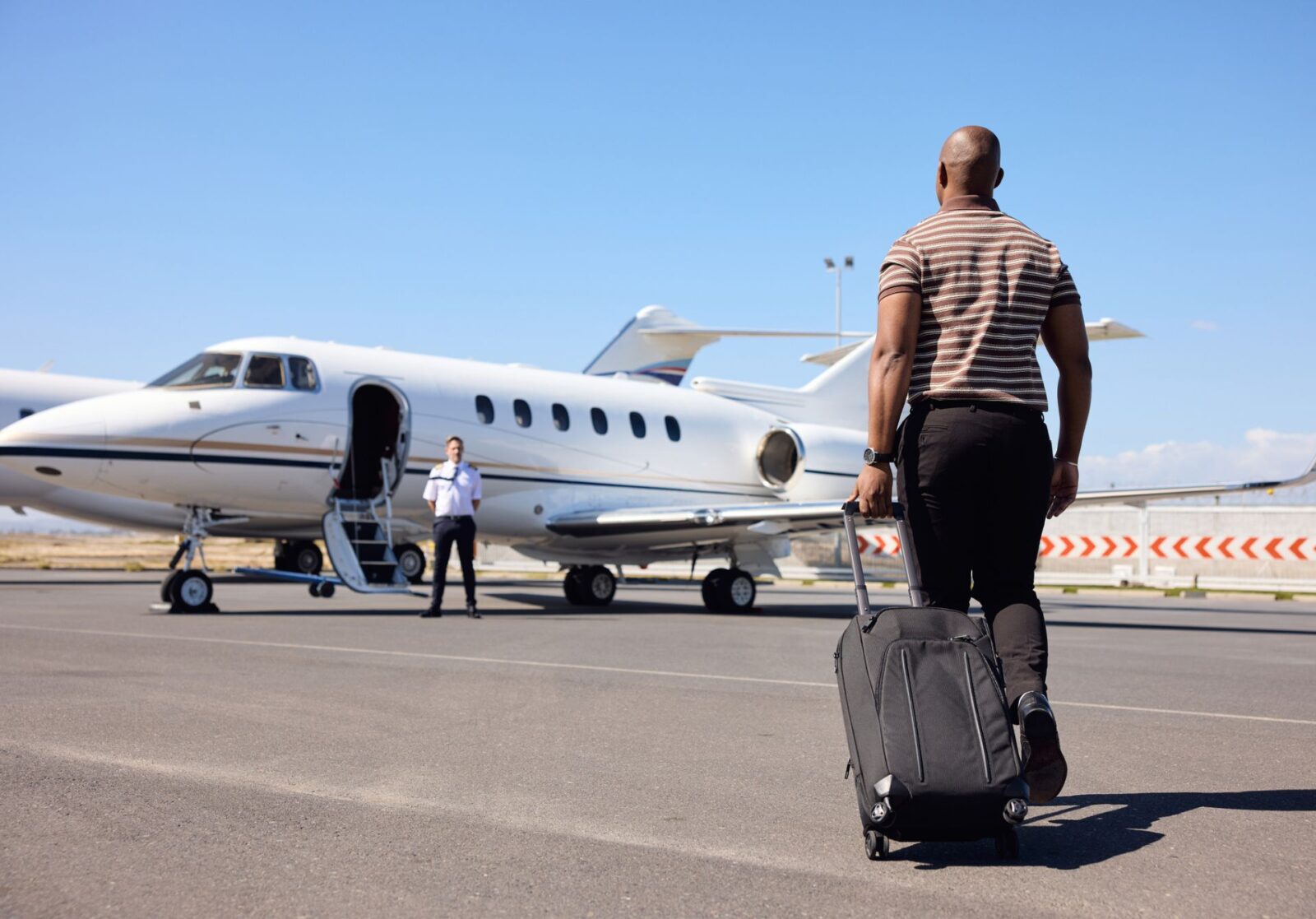
The most important factor may be proximity to the plane. FBOs are situated immediately adjacent to the ramp where the plane is parked. There are no buses or jet bridges to board. In most instances, passengers go from the lounge directly to the plane in just a few steps.
Arrival and Departure Procedures for Private Flights
Departure procedures are simple and personalized. Upon arrival at the FBO, passengers check in while the crew makes final preparations for departure.
Upon completion of these preparations, passengers are escorted directly to their plane.
No passenger groups are called; no announcements are made; and no gate changes are involved. Boarding takes just a few minutes.
Upon arrival at their destination, passengers disembark and go through the arrival lounge. They are immediately greeted, and their luggage is brought out of the plane’s hold.
The timing of these events is carefully managed between crew and ground staff. Planes are not started until passengers are aboard.
How Early Do You Need to Arrive
One of the most surprising aspects of flying on a private jet is how little time you actually have to arrive before departure. For domestic flights, passengers arrive 10-30 minutes before departure.
International flights may take longer, especially when exit formalities are involved. Even in these instances, however, arrival times are much shorter than those required for commercial flights.
Because the flight is on the passenger’s schedule rather than a timetable, time may be flexible within certain constraints. If the passengers are delayed by traffic, the time may be adjusted, provided that airport slots, crew duty, and air traffic permits are available.
However, arriving extremely late may cause some complications, especially if the airport is busy and the flight has a specific departure time.
Customs and Immigration
International flights require additional formalities, but these tend to be more streamlined than those for commercial flights.
Many larger airports have a customs and immigration section within the airport, either in the FBO building or adjacent to it. They either meet the aircraft upon arrival or escort the passengers to a private room within the airport terminal. They inspect each passenger’s documentation individually, and the process is quick.
In some countries, the formalities may be conducted right next to the aircraft, while in other countries, the passenger may be escorted to a controlled area within the airport terminal.
It is important to note that the formalities for international flights require advanced coordination. Inaccurate documentation may delay the passenger’s clearance, regardless of flight class.
Ground Transportation Coordination
Ground transportation services are typically coordinated in advance and aligned with the flight schedule, and they may range from executive sedans to executive SUVs, vans, and even coaches, depending on the number of passengers.
In many airports, the ground vehicles may drive right onto the ramp. This enables the passengers to get from the aircraft to the waiting chauffeur without entering the airport terminal building. At some airports, the chauffeur may be waiting outside the FBO entrance.
They monitor the flight’s progress and make the necessary adjustments for their arrival. If the flight leaves earlier than scheduled or faces delays, adjustments are made to align with the flight’s new schedule.
For complex travel plans involving multiple destinations, multiple vehicles or trucks with luggage, and security escorts, arrangements can be made. For large delegations, coordination is needed to ensure everyone moves efficiently and there is no congestion at the airport.
VIP Handling at Major Global Airports
For corporate executives, politicians, and other high-status individuals, private aviation can offer special handling. This can vary across airports but may include special security screening rooms, police escorts, and restricted access.
In some international airports with VIP handling facilities, special VIP terminals have been designed and are separate from the regular FBO. These are designed with the utmost privacy and security and can coordinate with government agencies or the airport authorities.
Security considerations can affect the scheduling and the locations where screening and access can be made. In some cases, baggage screening and documentation can be carried out of public view.
Traveling with Large Groups or Families
Private aviation can handle both large groups and families. The complexity of travel increases a bit with the number of people.
For families with children, private aviation offers advantages. Children don’t have to stand in long lines or wait for their parents. The flight can also be scheduled at a time that suits the family. Food can also be customized as needed.
For corporate groups, sports teams, and tour groups, the level of detail is naturally more complex. More aircraft may be involved, luggage requirements are naturally more extensive, and the process of getting passengers on board is more complex to ensure the flight is not delayed.
Some groups travel on larger aircraft, while others travel on multiple aircraft departing sequentially. Communication is naturally important to ensure that passengers arrive at the correct terminal and depart from the correct aircraft.